- Key Takeaway
- Every domain linking to a competitor has already decided your topic is worth referencing — making them pre-qualified outreach targets. Run a link gap analysis to find domains linking to competitors but not to you, prioritise by authority tier, and work the list systematically across editorial outreach, directory submissions, and community participation. Common Crawl's 4.4 billion link connections provide the data without subscriptions or API limits.
Competitor Backlink Analysis: How to Find Who Links to Your Competitors (And Get Those Links Too)
Most link building advice focuses on what you should do: write great content, reach out to bloggers, get listed in directories. What it rarely tells you is where to start. The cleanest starting point is not a list of generic tactics — it is your competitors' backlink profiles. The domains already linking to sites in your niche are pre-qualified targets. They link to similar content. They are reachable. And if five of your competitors share a link from the same resource site and you do not, that gap is not an accident — it is an opportunity with a clear address.
This article covers how competitor backlink analysis works, what to look for when you run one, and how to turn the results into a prioritised link building list you can act on immediately. It also covers how to check your domain's ranking authority before you start, because understanding where you stand relative to your competitors gives every subsequent decision better context.
Why your competitors' backlinks are your best research tool
When a website links to a competitor, it has already made a decision: this topic is worth referencing. The editorial work is done. You do not need to convince that site that your subject matter is relevant — someone already did. What you need to do is give them a reason to link to you as well, or instead.
This is fundamentally different from cold link building, where you are simultaneously trying to establish relevance and pitch your content to a site that may have no prior interest in your niche. Competitor backlink analysis skips that first hurdle entirely. Every domain in your competitor's backlink profile is a warm prospect by definition.
The link gap — the set of domains linking to a competitor but not to you — is the most actionable output of the whole exercise. It is not a theoretical list of sites that might link to you. It is a list of sites that demonstrably do link to content like yours and have not yet linked to you specifically. That distinction matters when you are deciding where to spend time on outreach.
Checking your domain authority before you start
Before analysing competitors, it is worth establishing your own baseline. Domain authority gives you a relative sense of where you sit in the link landscape — not as an absolute score, but as a comparison point against the sites you are benchmarking against.
The authority metric that matters most for understanding your position in the modern web is Harmonic Centrality from Common Crawl's web graph. Unlike traditional domain authority scores from Moz or Ahrefs, Harmonic Centrality measures how close you are to the centre of the entire web's link structure, not just how many links you have accumulated. It is the metric Common Crawl uses to determine crawl frequency, which means it directly influences how well represented your domain is in the data that trains large language models.
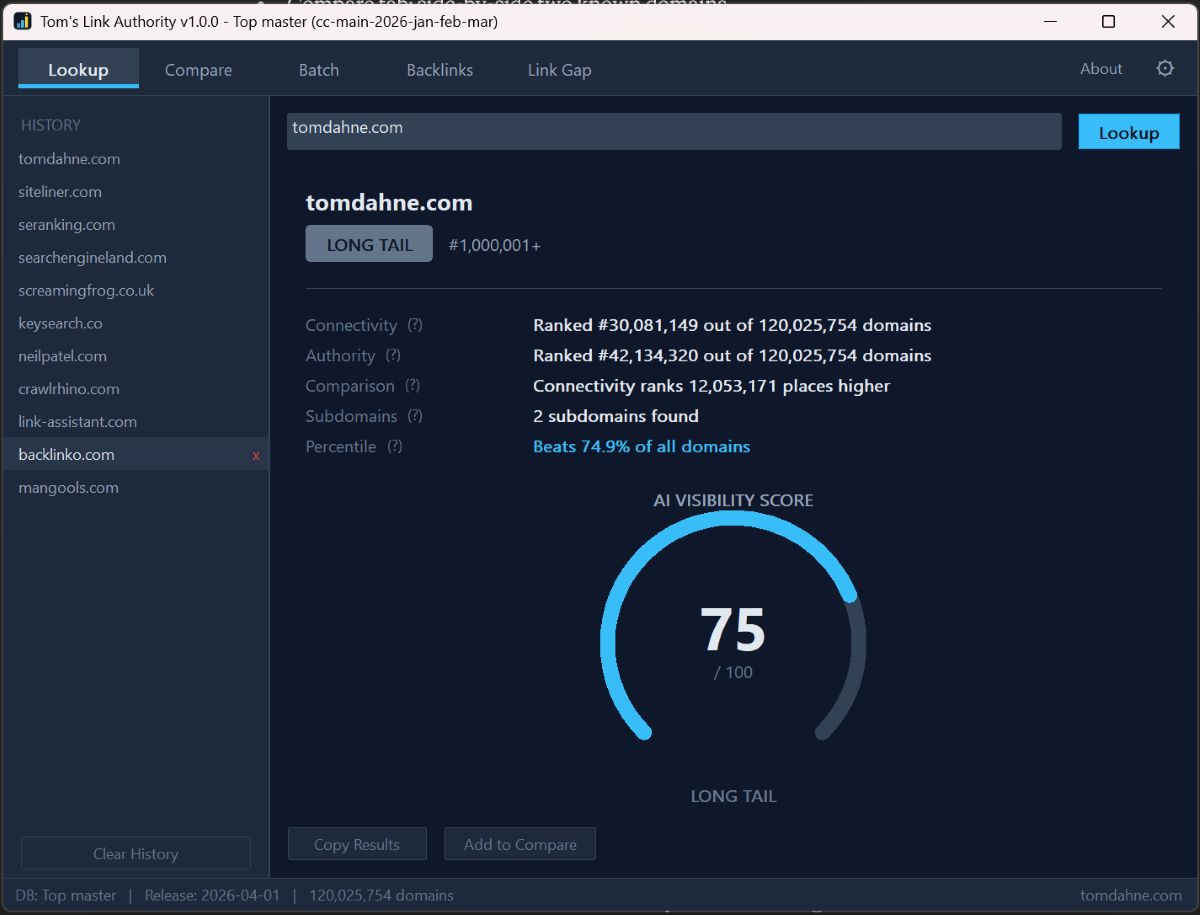
Tom's Link Authority shows you Harmonic Centrality rank, PageRank, AI Visibility Score, and tier classification for any domain from a database of 120 million domains — entirely offline, with no API limits or subscriptions. Check your domain alongside your top three or four competitors before you start the backlink analysis and you will immediately see whether you are at a structural authority disadvantage, roughly equal, or ahead. That context shapes how aggressive your outreach needs to be and which link opportunities to prioritise.
How to run a competitor backlink analysis
A backlink analysis answers one core question: which domains are linking to this site? The answer tells you who considers your competitor's content worth referencing, which gives you both outreach targets and a picture of the quality of the competitor's link profile.
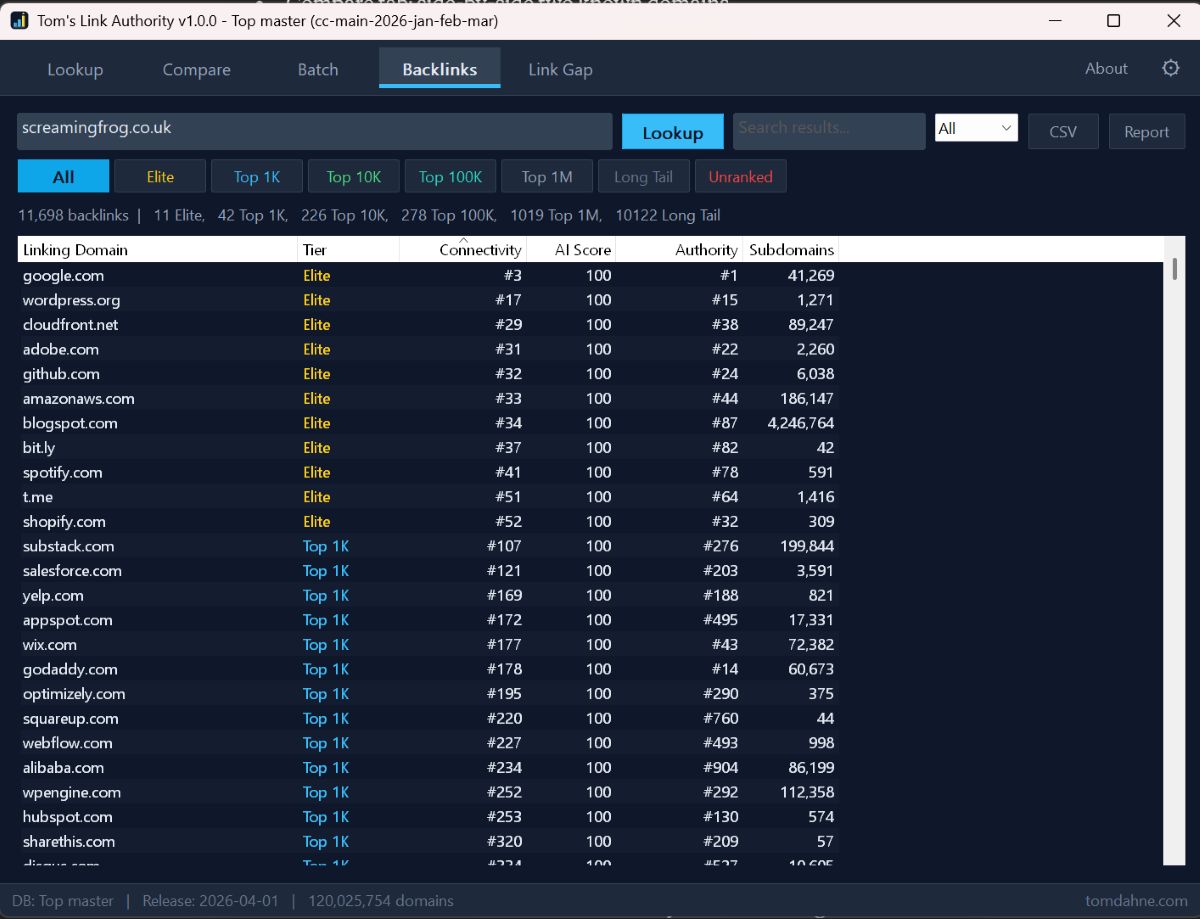
When you load a domain in TLA's Backlinks tab, it returns every domain linking to that target from Common Crawl's edge shard database — over 4.4 billion link connections across the web. Each result is ranked by authority tier, from Elite down to Long Tail, so you can immediately see the quality distribution of the backlink profile rather than just its size. A competitor with 500 backlinks from Long Tail domains is in a very different position to one with 80 backlinks including several from Tier 1 and Tier 2 sources.
Run this analysis on two or three competitors and compare what you find. Look for patterns rather than individual links. If a particular type of site — industry directories, resource pages, tooling roundups, community wikis — appears repeatedly across multiple competitor profiles, that category is telling you something about how your niche earns links. It is more useful to understand that pattern than to chase any single domain.
Filter results by tier before you start exporting. Tier 1 and Tier 2 domains are worth individual outreach. Long Tail domains at scale are better suited to bulk submissions where the barrier to getting a link is low. Treating both categories the same wastes effort in both directions.
Understanding the link gap
The link gap is the delta between a competitor's backlink profile and yours. Every domain in that gap has already demonstrated willingness to link to content in your space. Your job is to get on their radar.
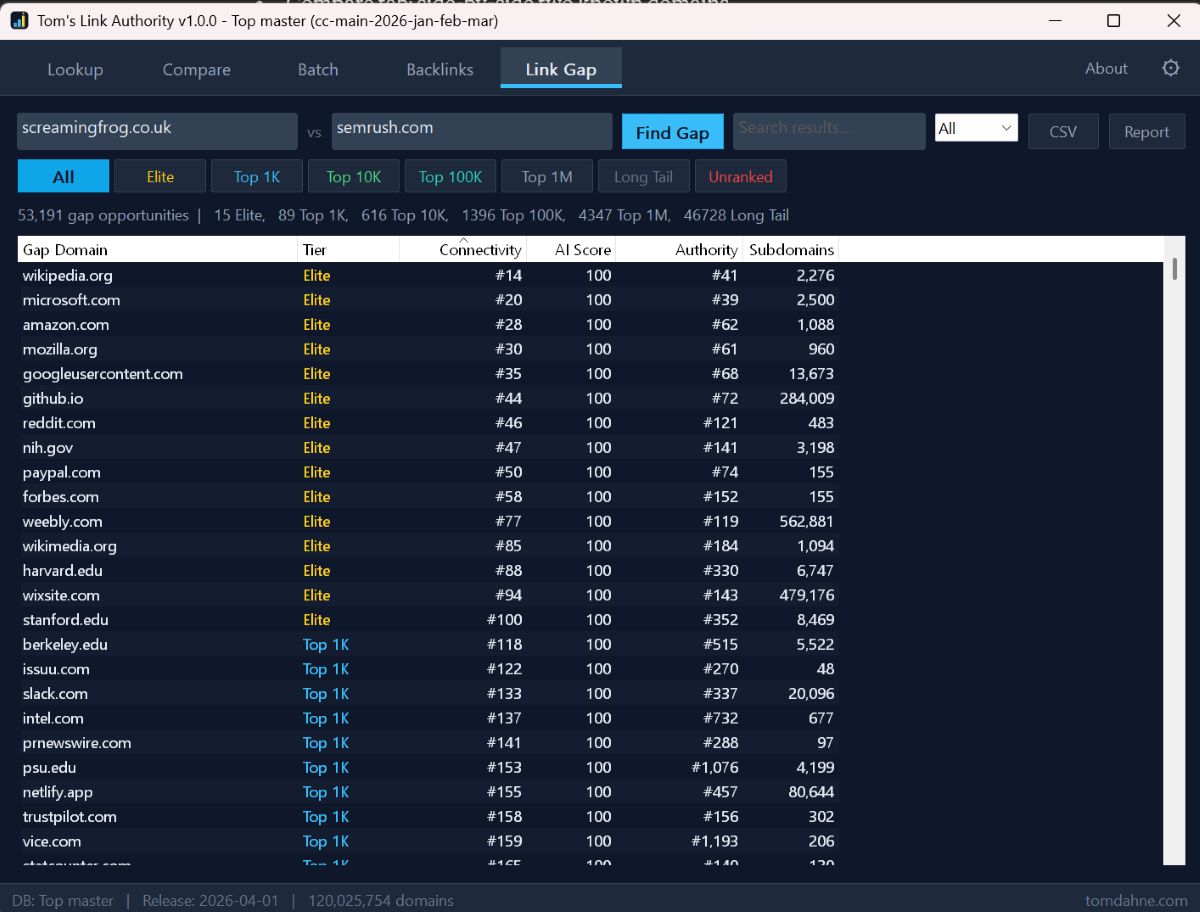
In practice, the link gap analysis works like this: you enter your domain and a competitor's domain, and the tool returns every domain linking to the competitor that is not yet linking to you. The results are sorted by authority, so the highest-value opportunities surface immediately. You are not hunting manually through spreadsheets or running queries against multiple tools — the gap is calculated directly from the same Common Crawl dataset used for both profiles, so the comparison is apples to apples.
A few things are worth looking for as you work through the gap results. First, look for domains where you already have some relationship — sites you have commented on, been mentioned in passing, or that cover your niche regularly. These are the warmest prospects because there is already some level of awareness. Second, look for resource pages and curated lists. These tend to link to multiple tools or services in a category, which means the barrier to getting added is lower than earning an editorial mention. Third, look for domains that appear in the link gaps of multiple competitors simultaneously. If three competitors all have a link from the same domain and you do not, that domain has a clear pattern of linking to your type of content and you should prioritise it.
The gap list is also useful in reverse. If a domain appears in your backlink profile but not in any competitor's, that link may be less strategically valuable than it appears — it could be an outlier rather than a signal of relevance in your niche.
Prioritising your outreach list
The output of a competitor backlink analysis is a list of opportunities, not a to-do list. Not every domain in the gap is worth pursuing. Prioritisation is where the real work starts.
Sort by authority tier first. Tier 1 and Tier 2 domains — those with high Harmonic Centrality and strong positions in the web's link graph — should get individual, personalised outreach. A single link from a well-connected domain moves your authority more than dozens of links from peripheral sites. These are worth real effort: finding the right contact, writing a relevant pitch, and following up.
Mid-tier domains are often the most efficient target. They are reachable with a reasonably personalised email, they carry meaningful authority, and there are usually enough of them in any gap analysis to keep a systematic outreach campaign running for weeks. This tier is where most of the practical link building volume happens for a site at your stage.
Long Tail domains in the gap are worth pursuing opportunistically but not systematically. If a low-authority site runs a resource list and the submission process takes five minutes, submit. Do not spend forty minutes crafting a pitch for a domain with no meaningful authority signal.
Authority tier is a proxy for link value, not a guarantee. A Long Tail domain with a highly relevant, frequently visited page in your exact niche can drive more referral traffic than a Tier 2 domain where your link would sit buried in a generic resource list nobody reads. Use tier as a filter, not a rule.
Common Crawl as a backlink data source
It is worth understanding what Common Crawl data is and why it matters as a source for backlink analysis. Common Crawl is a nonprofit organisation that has crawled the web continuously since 2008. Its quarterly crawls cover billions of pages and produce a complete web graph — a map of how domains link to each other across the entire crawl, with authority scores calculated for every domain in the dataset.
This is the same data used to train large language models including ChatGPT, Claude, and Gemini. Domains that are well-represented in Common Crawl's web graph appear more frequently in AI training data, which means they are more likely to be known and referenced by AI systems. That connection between backlink profile, Harmonic Centrality, and AI visibility is not coincidental — it is structural. Building links from well-connected domains improves your position in the web graph, which improves your Common Crawl representation, which feeds forward into AI visibility over time.
The practical difference for backlink analysis is that Common Crawl's dataset is comprehensive in a way that proprietary crawlers are not. It covers 4.4 billion link connections across 120 million domains. Its coverage is not limited by a commercial database built to serve a subscription product — it is built to map the entire web, updated quarterly, and publicly available. TLA processes this data locally on your machine, so there are no API limits, no rate limiting, and no subscription costs eating into your outreach budget.
Running the analysis in Tom's Link Authority
The workflow is straightforward. Download the app from tomdahne.com/link-authority and run it — no installation required, single portable exe. On first launch, download a rank database from the settings panel. The free tier covers up to 25 million domains and is sufficient for authority lookups on all but the largest sites. Purchase the backlink shards for the domains you want to analyse — each shard covers one letter of the alphabet, priced at $5 per quarterly update, and every purchase includes a bonus download of the full 120 million domain Master Ranks database.
Once your shards are loaded and your license key is entered in settings, the Backlinks and Link Gap tabs unlock. Start with the Lookup tab to check your domain's authority baseline alongside your top competitors. Then switch to the Backlinks tab and enter a competitor domain to see their full backlink profile ranked by tier. Export to CSV if you want to work through the list in a spreadsheet. Then switch to the Link Gap tab, enter your domain and the same competitor, and the tool returns the gap — every domain linking to them but not to you, sorted by authority.
Repeat this for each competitor you want to analyse. Export each gap to CSV. Merge the lists, deduplicate, and sort by authority. That combined output is your link building hit list — pre-qualified, prioritised, and ready to work through systematically.
What to do with the results
The backlink data tells you where to look. What you do next depends on the type of site each opportunity represents.
For editorial mentions and resource pages, the goal is to give the site a reason to reference you. If a blog has written a roundup of SEO tools and linked to three of your competitors but not you, the pitch is simple: here is what makes our tool different, here is who it is for, here is the link. Keep it short and make it easy for them to add you without having to do research. If your tool genuinely belongs in that list, a well-timed email often works.
For directories and curated listings, the process is usually a submission form rather than an outreach email. Work through these efficiently. Have a standard set of copy ready — tool name, one-line description, longer description, URL, category — so each submission takes minutes rather than half an hour.
For community sites, forums, and question-answer platforms, the approach is contribution first, link second. If a domain in your gap is a community where people ask questions about SEO tools or link building, the right move is to become a genuine participant and let the links follow naturally from being useful. Dropping a link in a forum thread you have never contributed to reads as spam and usually gets removed.
Track everything. A simple spreadsheet with domain, tier, outreach date, status, and result is enough. Link building is a numbers game over a long timeline — knowing which types of sites convert at what rate helps you refine where to spend effort in future rounds.
How often to run competitor backlink analysis
Common Crawl publishes new web graph data quarterly. Running a full competitor backlink analysis every quarter keeps your gap list current and lets you catch any new link sources your competitors are picking up. In practice, a quarterly review combined with a monthly spot-check on any particularly active competitors is a reasonable rhythm for a solo operator or small team.
The goal is not to chase every new link your competitor earns in real time. It is to systematically close the structural gaps in your backlink profile over months and years. Sites that consistently do this kind of analysis and act on the results tend to build stronger, more relevant link profiles than sites that rely on reactive or opportunistic link building alone.
Getting started
If you want to run your first competitor backlink analysis today, Tom's Link Authority is free to download. The Lookup, Compare, and Batch tabs work immediately with the free rank database — no license key required. Purchase the backlink shards for the competitor domains you want to analyse and the Backlinks and Link Gap tabs unlock. The full 120 million domain Master Ranks database is included free with any shard purchase.
Everything runs offline on your Windows machine. No subscriptions, no API limits, no account creation. The data comes directly from Common Crawl's quarterly web graph — the same dataset used to train the AI systems increasingly shaping how content gets discovered and cited online.
Download Tom's Link Authority Free →
Also worth trying: Tom's Site Auditor — find every SEO issue on your site →