- Key Takeaway
- You do not need a $139/month SEO platform for a small site. Google Search Console (free) covers query and indexing data, budget keyword tools like Mangools or KeySearch cost $24–$29/month, and one-time purchase desktop tools like Tom's Site Auditor handle technical auditing for a single $29 fee with no recurring costs. A complete SEO stack for under $30/month — or $0/month after one-time purchases — is realistic in 2026.
Cheap SEO Tools That Actually Work in 2026 (Including One You Buy Once and Own Forever)
If you've searched for SEO tools recently you already know the problem. Every tool wants $99 to $139 per month. That's up to $1,668 a year — for software that tells you what's wrong with your website but doesn't fix anything.
For freelancers, small business owners, bloggers, and anyone just getting started, that price point is simply not justifiable. Especially when you're not yet sure SEO is going to pay off for your specific situation.
The good news: there are genuinely capable SEO tools available for under $30 a month, tools with one-time pricing, and free options that cover the basics properly. This article covers all three — with honest notes on what each one actually does well and where it falls short.
Quick answer if you're in a hurry: start with Google Search Console (free, essential), add one budget keyword tool like Mangools or KeySearch for research, and use Tom's Site Auditor as a one-time purchase for site auditing. Total ongoing cost: $24–$30 per month plus a one-time fee for the auditor. No $139/month platform required.
Why the expensive tools feel like a trap
Ahrefs, SEMrush, and Moz Pro are genuinely powerful. Nobody's arguing otherwise. But they're built for agencies and large teams who need to run competitive research across hundreds of clients and domains simultaneously. That's who the pricing is designed for.
For a single website owner or a freelancer with a handful of clients, you're paying for infrastructure you'll never use. And because they're subscription-based, the moment you stop paying you lose access to all your historical data. You don't own anything — you're renting access indefinitely.
The frustration people express about these tools isn't really about the features. It's about paying $1,668 a year for something that returns maybe $200 a year in actual measurable value for their situation. The ROI just isn't there at the small end.
Free tools you should be using regardless
Before spending anything, make sure you're actually using what Google provides for free. Most site owners set these up and then never properly learn them — which means they're flying blind on data that's already available.
Google Search Console — Free
The single most important SEO tool available, and it costs nothing. Search Console shows you exactly which queries your pages appear for, how many impressions and clicks each page gets, your average position, and any technical issues Google has found — crawl errors, indexing problems, mobile usability issues. If you only ever use one SEO tool, this is it. Set it up properly and actually read it weekly.
Google Analytics — Free
Pairs with Search Console to show where your traffic comes from, how long people stay, which pages lead to conversions, and where you're losing people. The GA4 version has a learning curve but it's settled down now and the data is invaluable.
Google Keyword Planner — Free
Originally built for Google Ads, it's still a solid keyword research starting point. You need an Ads account to see precise volume numbers rather than ranges, but even the ranges are useful for initial research.
Ahrefs Webmaster Tools — Free
Ahrefs offers a free tier for verified site owners that includes limited backlink data and a site audit for your own domains. The crawl audit alone is worth setting up — it surfaces technical issues that Search Console sometimes misses.
Google Trends — Free
Useful for checking whether a keyword is growing or declining in popularity before investing content effort into it. Also good for spotting seasonal patterns and comparing topics head to head.
Honest advice: most people who say free tools aren't enough haven't actually mastered the free tools yet. Spend a month properly learning Google Search Console before paying for anything else. You'll be surprised how much it tells you.
Best cheap paid SEO tools in 2026
Once you've hit the ceiling of free tools, these are the options worth paying for — all significantly cheaper than the premium platforms, and all capable enough for the majority of small site use cases.
Tom's Site Auditor — One-time $29
This is the option that's genuinely different from everything else on this list. It's not a subscription. You pay once, you own it permanently, and you can audit as many websites as you want for as long as you want — no monthly bill, no credit system, no account required.
Tom's Site Auditor is a Windows desktop application that crawls your website locally — meaning everything runs on your own computer, nothing is uploaded to a server. It checks over 30+ SEO factors per page: title tags, meta descriptions, canonical tags, heading structure, internal linking, page speed indicators, broken links, duplicate content, image optimisation, Open Graph tags, and more. It exports a full HTML report you can read in any browser or share with a client.
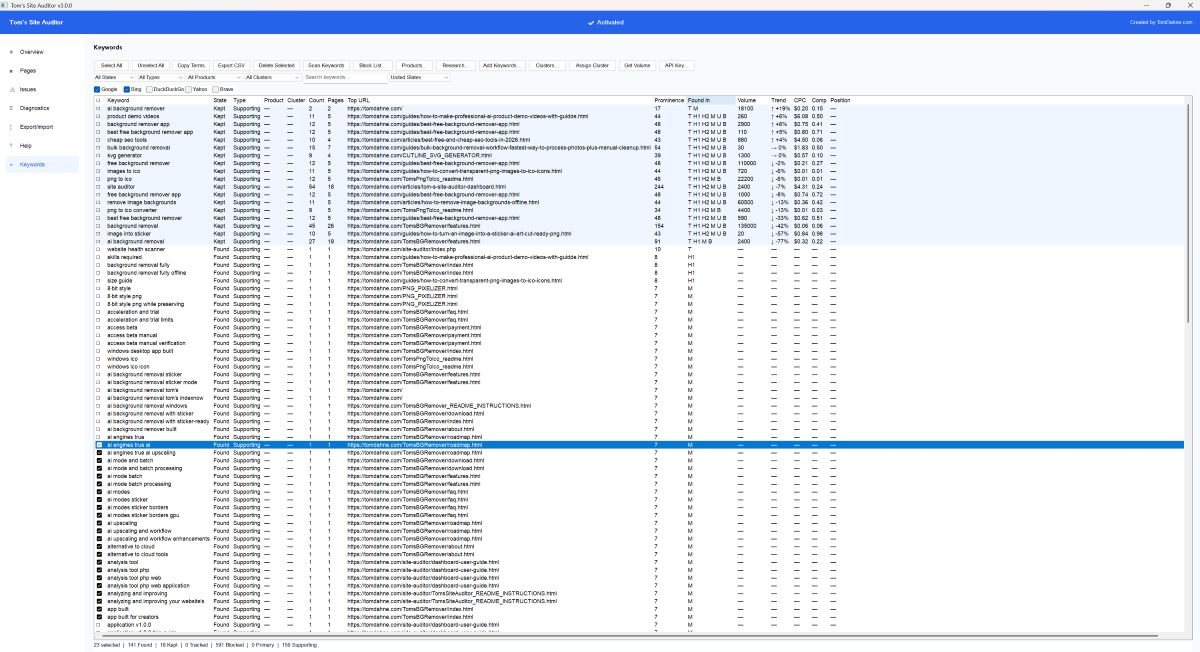
The paid version also includes the SEO Dashboard — a self-hosted PHP analysis console that loads your scan data and generates client-ready reports with one click — and Site Fixer, a PHP script that applies common fixes (missing canonical tags, OpenGraph tags, image dimensions) directly to your HTML files from the browser. And with version 3 on the horizon — bringing a full Keyword Website Miner, keyword volume tracking, and more — it's shaping up to be one of the most complete one-time-purchase SEO tools available.
Version 3 is out now: Tom's Site Auditor v3 includes a built-in Keyword Website Miner, keyword volume data tracking, and more — turning it into a complete SEO workflow tool for a one-time price. Grab v2.9.4 now and get the v3 upgrade at no extra cost when it lands.
What it doesn't do: rank tracking, backlink database. For those you'll need one of the tools below. But for technical site auditing and finding what's broken on your own site, it's the most cost-effective option available — full stop.
KeySearch — $24/month
The most popular budget keyword research tool for bloggers and affiliate site owners. Covers keyword difficulty scoring, volume data, competitor analysis, and content research. Uses the Moz API for domain authority data. Not as deep as Ahrefs but covers the keyword research fundamentals properly at a price that's hard to argue with. Good for content-focused sites where keyword research is the main ongoing need.
Mangools (KWFinder) — ~$29/month
Five tools bundled under one price: KWFinder for keyword research, SERPChecker for SERP analysis, SERPWatcher for rank tracking, LinkMiner for backlink research, and SiteProfiler for domain analysis. The interface is notably cleaner and more beginner-friendly than most competitors. KWFinder's keyword difficulty scores are generally considered more realistic than some alternatives. Frequently described as the best value all-rounder in the budget space.
Ubersuggest — from $12/month or ~$120–$299 lifetime
Neil Patel's entry-level platform covers keywords, site audits, backlink data, and content ideas. The lifetime deal is the main reason people choose it over Mangools — pay once and avoid the recurring cost entirely. Quality is a step below the premium tools but more than adequate for beginners building their first site or running a small business with straightforward SEO needs.
SE Ranking — from $44/month
The most complete all-in-one option at the budget end. Solid rank tracking, site audits, backlink monitoring, competitor research, and white-label reporting. Annual billing brings it down to a more manageable monthly equivalent. The right choice for freelancers managing multiple client sites who need a proper platform without Ahrefs pricing.
Screaming Frog SEO Spider — Free up to 500 URLs / £259/year paid
The industry-standard desktop crawler for technical SEO. Free version handles up to 500 URLs which covers most small sites. The paid annual licence is a flat fee — cheaper than most cloud alternatives. Worth knowing about as a complement to Tom's Site Auditor if you need to crawl very large sites regularly.
Comparison table
| Tool | Price | Site Audit | Keywords | Rank Tracking | Backlinks | Best For |
|---|---|---|---|---|---|---|
| Tom's Site Auditor | $29 one-time | ✅ 30+ checks | ✅ On-page | ❌ | ❌ | Technical auditing, no subscription, offline privacy |
| KeySearch | $24/mo | ✅ Basic | ✅ Strong | ✅ | ✅ Limited | Bloggers, affiliate sites, content research |
| Mangools | ~$29/mo | ✅ Basic | ✅ Strong | ✅ | ✅ Limited | Beginners, clean UI, all-round budget tool |
| Ubersuggest | $12/mo or ~$120–299 lifetime | ✅ Basic | ✅ | ✅ | ✅ Limited | Beginners, lifetime deal seekers |
| SE Ranking | from $44/mo | ✅ Strong | ✅ Strong | ✅ Strong | ✅ | Freelancers, multiple client sites |
| Google Search Console | Free | ✅ Indexing | ✅ Your queries | ✅ Your site | ❌ | Everyone — non-negotiable foundation |
| Ahrefs Webmaster Tools | Free | ✅ Limited | ❌ | ❌ | ✅ Your site | Free backlink data for your own domains |
The case for one-time pricing over subscriptions
Every tool in the subscription column above is charging you whether you're actively using it or not. Take a month off from content creation, go on holiday, get busy with client work — the bill comes anyway. Over three years, a $29/month tool costs $1,044. Over five years, $1,740.
A one-time purchase costs what it costs, once. Tom's Site Auditor at $29 one-time is cheaper than a single month of most premium platforms — and you keep it indefinitely. For technical site auditing specifically, there's no ongoing data cost that justifies a subscription model. The crawler runs on your machine. There's no server to maintain, no database of third-party keyword data to license. The one-time model is the honest pricing for what the tool actually is.
The subscription tools are not wrong to charge monthly for keyword data and backlink databases — those genuinely cost money to maintain at scale. But for site auditing, crawling, and technical analysis, a subscription is overhead you don't need to pay.
Recommended stacks by situation
Complete beginner — minimal spend
Google Search Console plus Google Analytics for traffic data, Ahrefs Webmaster Tools for free backlink checks on your own site, and Tom's Site Auditor as a one-time purchase to run technical audits and find what needs fixing. Ongoing monthly cost: $0.
Blogger or content site owner
Google Search Console as the foundation, KeySearch or Mangools for keyword research and difficulty analysis, Tom's Site Auditor for periodic technical audits. Around $24–$29 per month plus the one-time auditor fee.
Freelance SEO or small agency
SE Ranking for the all-in-one platform across multiple client projects, Tom's Site Auditor for deep offline technical crawls and client reports, Google Search Console integrated for each client. Around $44/month plus a single one-time tool purchase.
Small business owner, one website
Google Search Console properly set up and actually read weekly, Ubersuggest lifetime deal for keyword ideas and site audit basics, Tom's Site Auditor for a proper technical crawl every few months. One-time costs only, no ongoing subscription required.
What to avoid
A few things worth steering clear of in the budget SEO space:
Group buys. Shared accounts for premium tools, usually sold via forums for a few dollars a month. They violate terms of service, get banned regularly, and disappear without warning. The money saved is not worth losing access mid-project.
Lifetime deals from unknown vendors. AppSumo and Dealify do feature legitimate lifetime deals on real tools. But unvetted vendors offering "Ahrefs-level features for $49 lifetime" on random affiliate sites are almost always vaporware or severely limited tools. Check reviews carefully.
Paying for subscriptions before you've used the free tools properly. If you haven't spent real time in Google Search Console, you're not at the ceiling of what free tools can tell you. Don't buy a monthly subscription to solve a problem that free data might already answer.
Final thoughts
You don't need a $139/month tool to do meaningful SEO on a small site. The free Google tools cover a lot of ground, the budget keyword platforms have genuinely caught up for most use cases, and for technical site auditing specifically a one-time purchase is a smarter model than a subscription.
Start with what's free, add one paid tool that matches your biggest gap — usually keyword research — and use Tom's Site Auditor for the technical audit layer without adding another monthly line item to your costs.
The goal is to spend less time managing tool subscriptions and more time actually improving your site.